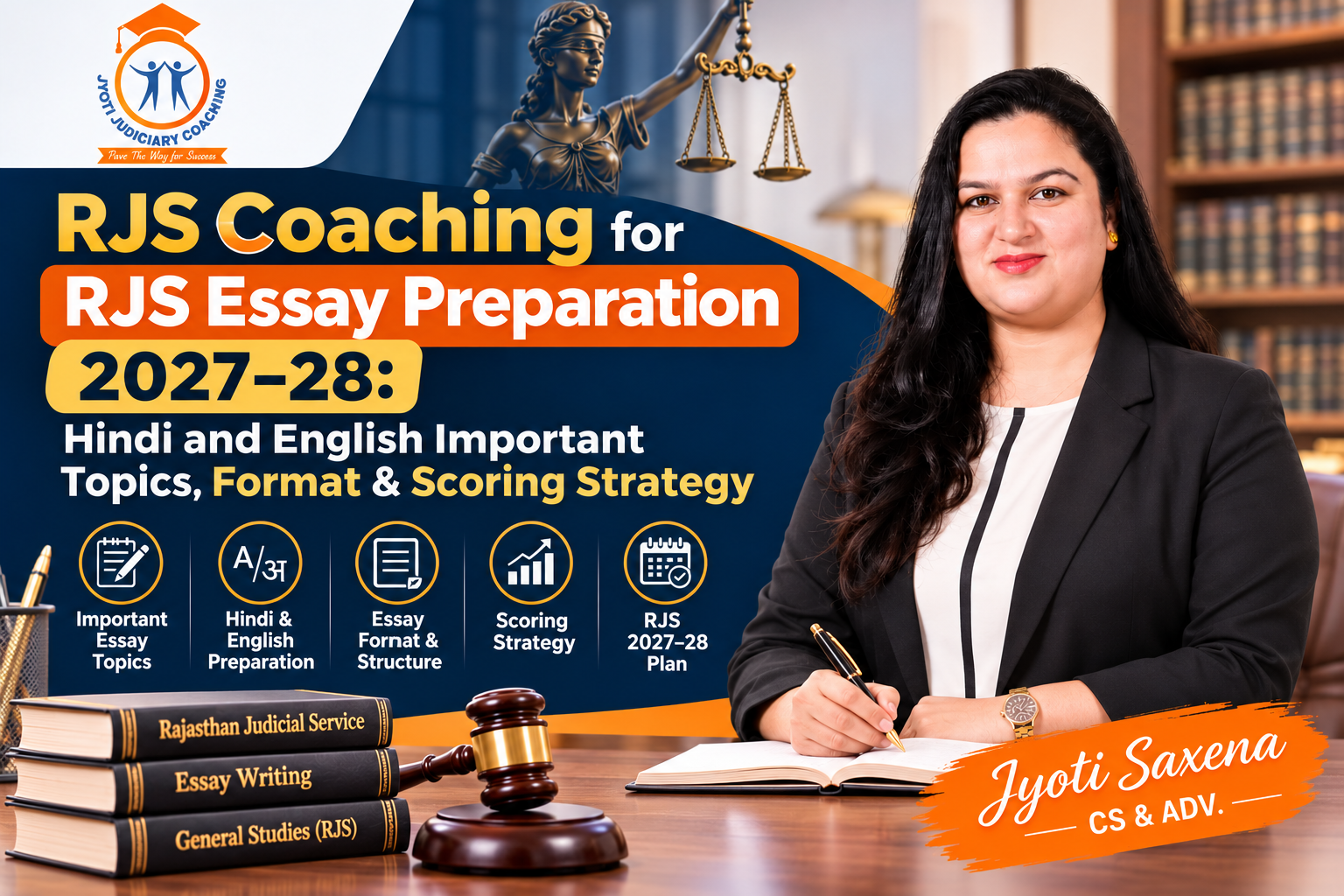
RJS Coaching for RJS Essay Preparation 2027-28: Hindi and English Important Topics, Format & Scoring Strategy
RJS Mains essay papers carry 100 marks in total — 50 marks each for Hindi and English. Many candidates lose the exam right here, not because they lack knowledge, but because they never practice the format. At Jyoti Judiciary Classes in Jaipur, our faculty works specifically on essay structure, legal language, and time management so that students walk into the exam hall confident about both papers.
RJS Mains Essay Paper Pattern 2027-28
The Rajasthan Judicial Service mains examination includes two separate essay papers. Paper I is the Hindi Essay paper, worth 50 marks, with a time limit of two hours. Paper II is the English Essay paper, also worth 50 marks, with the same two-hour duration. Both papers test your ability to think clearly, write precisely, and connect your arguments to constitutional values or legal reasoning wherever relevant.
Word limit per essay typically ranges from 600 to 800 words. The examiner evaluates your introduction, logical flow of arguments, use of relevant legal terms or case laws, and the quality of your conclusion. Language and presentation also carry weight — especially in the English essay, where grammar and sentence clarity are assessed directly.
Important Hindi Essay Topics for RJS Mains
Hindi essay topics in RJS Mains draw from constitutional issues, social reform, governance, and current public discourse. Based on past papers and likely areas for 2027-28, the following topics deserve focused preparation:
- न्यायपालिकाकीस्वतंत्रताऔरजवाबदेही (Judicial Independence and Accountability)
- महिलासशक्तिकरणऔरकानूनीअधिकार (Women Empowerment and Legal Rights)
- पर्यावरणसंरक्षणऔरसततविकास (Environmental Protection and Sustainable Development)
- भ्रष्टाचारमुक्तभारतकीराह (Path to Corruption-Free India)
- तकनीकऔरन्यायप्रणाली (Technology and Justice System)
- ग्रामीणभारतमेंन्यायतकपहुंच (Access to Justice in Rural India)
- संवैधानिकमूल्यऔरलोकतंत्र (Constitutional Values and Democracy)
- साइबरअपराधऔरकानूनीचुनौतियां (Cyber Crime and Legal Challenges)
- मानवाधिकारबनामराष्ट्रीयसुरक्षा (Human Rights vs. National Security)
- न्यायिकसक्रियताकीसीमाएं (Limits of Judicial Activism)
At Jyoti Judiciary Classes, we assign three to four essay topics every week during the mains preparation phase. Students write under timed conditions and receive individual feedback on structure and legal reasoning.
Important English Essay Topics for RJS Mains
English essay topics for RJS Mains 2027-28 fall broadly into constitutional law, access to justice, social issues, and policy debates. Topics that require a legal perspective will score higher when you use relevant case law or statutory references naturally within the essay. Key topics to prepare include:
- Judicial Activism vs. Judicial Restraint
- Access to Justice in Rural Rajasthan
- Technology in Criminal Evidence and Digital Courts
- Gender Justice and Legal Reforms in India
- Fundamental Rights During National Emergency
- Role of Lok Adalats in Reducing Pendency
- Environmental Law and the Right to a Healthy Environment
- Victims’ Rights and Criminal Justice Reform
- Uniform Civil Code: Arguments For and Against
- Media Trial and the Right to Fair Trial
Essay Writing Format for RJS Mains
A well-structured essay is non-negotiable for high marks. Whether you are writing in Hindi or English, follow this format every time you practice:
Introduction (10–15% of total words)
Start with a compelling first line — a relevant quote, a constitutional provision, a Supreme Court observation, or a striking factual statement. Define the key term in the topic. State your central argument or thesis clearly in two to three sentences.
Body (60–70% of total words)
Divide the body into three to five clearly argued paragraphs. Each paragraph should have one main idea, two to three supporting sentences, and a concluding link to the next point. Use legal terms naturally — cite Articles, sections of law, or landmark judgments where they strengthen the argument. Do not list facts mechanically; weave them into reasoned prose.
Counter View and Rebuttal
A strong essay acknowledges the opposing view. Spend two to three sentences presenting the counter argument, then rebut it with evidence or legal reasoning. Examiners value balanced, judicial thinking — the ability to see both sides before reaching a conclusion.
Conclusion (10–15% of total words)
Summarise your main argument without simply repeating what you wrote. End with a forward-looking line — a recommendation, a constitutional aspiration, or a judicial principle. The conclusion should feel like a judgment, not a summary.
Scoring Strategy: How to Maximise Marks in RJS Essay Papers
The difference between 35 and 45 marks in an essay paper is not knowledge — it is presentation and strategy. Here is what works:
- Spend 10 minutes planning: Before you write a single word, jot down your outline — introduction angle, three to four body points, counter view, conclusion line. This prevents mid-essay confusion and saves time overall.
- Use legal vocabulary with purpose: Terms like writ jurisdiction, right to equality, doctrine of proportionality, or judicial review add authority. Use them only when they genuinely fit the argument, not to impress.
- Cite case laws naturally: Mention Maneka Gandhi v. Union of India, Vishaka v. State of Rajasthan, or M.C. Mehta v. Union of India where relevant. A well-placed judgment reference can lift an essay’s score significantly.
- Maintain word discipline: Practice writing essays of exactly 650–750 words. Going significantly over or under the expected word limit signals poor time management to the examiner.
- Practice both languages equally: Many candidates prepare only Hindi essays and treat English as secondary. Both carry equal marks. In our RJS coaching classes in Jaipur, we run parallel mock sessions for both papers.
- Get your essays evaluated: Self-evaluation has limits. Submit your essays for expert feedback — grammar errors in the English paper and structural weaknesses in Hindi essays are only visible to someone who has marked such papers before.
How Jyoti Judiciary Classes Prepares You for Essay Papers
Advocate Jyoti Saxena and the faculty at Jyoti Judiciary Classes know that essay preparation cannot be left to the last month. From the beginning of the mains batch, essay writing is part of the weekly schedule — structured topics, timed sessions, written feedback, and model answer discussions.
Our students from Rajasthan and across India attend live classes and practice sessions through our online platform. Batches at Jyoti Judiciary Classes include Saturday mock tests and dedicated judgment-writing workshops that directly strengthen essay language and legal reasoning. With 468+ selections across state judiciaries, our track record shows that systematic essay preparation is one of the highest-return activities in the entire RJS mains calendar.
Frequently Asked Questions
What is the word limit for RJS Mains essay papers?
Each essay in the RJS Mains is expected to be around 600 to 800 words, though the exact limit may vary by question. Practice within this range to develop a consistent writing pace.
How many marks do the essay papers carry in RJS Mains?
The Hindi Essay paper is worth 50 marks and the English Essay paper is worth 50 marks. Together they carry 100 marks out of the RJS Mains total.
Can I use case laws and legal terms in the RJS essay?
Yes, and you should. Relevant case laws, constitutional provisions, and legal terms used naturally in the argument demonstrate legal reasoning — a quality examiners actively reward in judicial service essays.
How should I practice Hindi essays for RJS Mains 2027-28?
Write three to four essays per week on current constitutional and social issues. Focus on structure — introduction, body, counter view, conclusion. Get each essay evaluated for language, relevance, and legal depth. Avoid writing essays only in your head; written practice is the only way to build speed and clarity.
Does Jyoti Judiciary Classes offer dedicated essay preparation for RJS?
Yes. Our RJS mains batches in Jaipur include weekly essay writing sessions for both Hindi and English papers, with written feedback from faculty, model answer discussions, and Saturday mock tests. Students can also join online live classes from anywhere in India.